
-6%
$90.00 Original price was: $90.00.$85.00Current price is: $85.00.
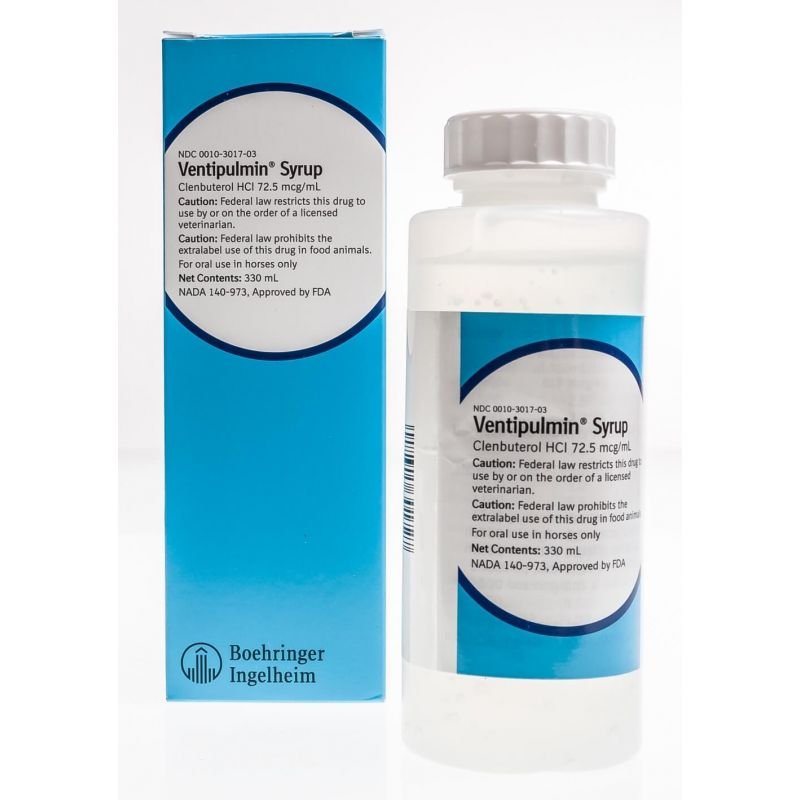
Ventipulmin Syrup 330mL is an oral veterinary medicine containing clenbuterol hydrochloride 72.5 micrograms per mL. The U.S. FDA-approved labeling identifies Ventipulmin Syrup as being for oral use in horses only and indicates it for management of horses affected by airway obstruction, such as that associated with chronic obstructive pulmonary disease (COPD).
The 330mL presentation is supplied in a plastic bottle and carries NDC 0010-3017-03 in the U.S. labeling. The product is a prescription animal drug, and U.S. federal labeling restricts its use to or on the order of a licensed veterinarian.
Clenbuterol is a beta-2 adrenergic agonist with bronchodilating properties. By acting on the airways, it can help improve airflow when bronchospasm and airway obstruction are contributing to respiratory difficulty.
Ventipulmin Syrup 330mL is therefore particularly relevant to veterinary management of equine respiratory disease where a bronchodilator is clinically appropriate. It should be used according to the veterinarian’s diagnosis and the current product label applicable to the horse’s location.
Ventipulmin Syrup is a clenbuterol hydrochloride oral solution for horses.
The U.S. label specifies:
The manufacturer describes the product as a colorless, palatable syrup, which can make oral administration practical when prescribed for horses.
Ventipulmin is specifically formulated for equine respiratory care.
Respiratory problems in horses can involve airway narrowing, bronchospasm, inflammation, mucus accumulation and impaired airflow. Depending on the underlying disease, veterinarians may use bronchodilators as part of a broader treatment plan.
The FDA-approved U.S. indication states that Ventipulmin Syrup is intended for management of horses affected with airway obstruction, including obstruction associated with COPD.
This makes Ventipulmin 330mL a relevant product for veterinary professionals managing appropriately diagnosed equine airway disease.
The active ingredient in Ventipulmin is clenbuterol hydrochloride.
Each mL contains 72.5 micrograms of clenbuterol hydrochloride.
Clenbuterol belongs to the beta-2 adrenergic agonist class.
Its principal respiratory effect is bronchodilation. When bronchial smooth muscle contracts, the airway can become narrower. Stimulation of beta-2 receptors can promote relaxation of bronchial smooth muscle and help reduce airway resistance.
The product label describes clenbuterol as providing bronchodilating properties.
Airway obstruction can make it more difficult for a horse to move air through the respiratory tract.
In horses affected by bronchospasm, narrowing of the airways can contribute to:
Clenbuterol can help address the bronchoconstrictive component of respiratory disease through its bronchodilating action.
Importantly, Ventipulmin does not automatically treat every possible cause of coughing or breathing difficulty. A veterinarian should determine the underlying respiratory problem before treatment.
One of the best-known applications of Ventipulmin is the management of airway obstruction associated with chronic obstructive pulmonary disease in horses.
The current U.S. label specifically lists airway obstruction such as that occurring with COPD as the indication for Ventipulmin Syrup.
Equine respiratory disease can be influenced by environmental conditions, especially exposure to airborne particles.
Veterinary management may therefore involve both medication and environmental measures.
These can include improving:
The appropriate management plan depends on the individual horse.
Airway obstruction can interfere with normal breathing.
When airway narrowing is related to bronchospasm, a bronchodilator can help open the airways and facilitate airflow.
Ventipulmin’s active ingredient, clenbuterol hydrochloride, is specifically classified as a beta-2 adrenergic agonist with bronchodilating properties.
Veterinary assessment is important because airway obstruction can have different causes.
A horse experiencing persistent respiratory signs should receive an appropriate examination rather than relying solely on symptomatic treatment.
Respiratory disease in horses can present in different ways.
Possible signs include:
These signs can occur with numerous respiratory disorders.
Ventipulmin may be appropriate when airway obstruction is diagnosed and bronchodilation is part of the treatment objective.
Ventipulmin Syrup is administered orally.
The U.S. label provides a dosing system based on body weight and instructs that the prescribed volume should be measured and administered orally to the horse.
The product’s dispensing system is designed to allow the appropriate volume to be measured.
Because clenbuterol is pharmacologically active and the appropriate amount depends on the horse’s weight and clinical circumstances, owners should follow the veterinarian’s prescribed instructions rather than independently changing the amount.
Ventipulmin dosage should be determined according to the current product label and veterinary prescription.
The U.S. label includes weight-based administration and a dosage calculation chart based on body weight.
Because Ventipulmin is available in different formulations and concentrations internationally, customers should not transfer dosing instructions from another Ventipulmin product to the 330mL syrup without veterinary direction.
The 72.5mcg/mL U.S. syrup should be distinguished from other Ventipulmin formulations that may be marketed internationally.
Accurate measurement is important with prescription veterinary medicines.
A veterinarian can calculate the appropriate volume based on factors including:
Owners should not increase the dose simply because respiratory symptoms have not immediately improved.
Likewise, treatment should not be discontinued or modified without veterinary guidance.
The Ventipulmin name is used for more than one formulation.
This is particularly important when searching for the product online.
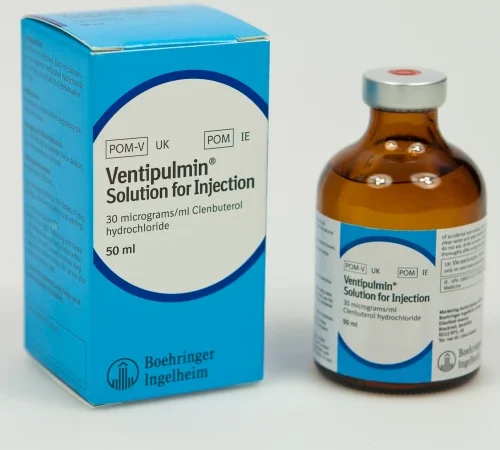
Some international markets have an injectable Ventipulmin formulation with a different concentration and administration route.
Therefore, Ventipulmin Syrup 330mL should never be confused with Ventipulmin Injection.
The route and concentration are different.
Respiratory health is particularly important in performance horses.
Even relatively modest airway obstruction can affect exercise tolerance.
A horse may appear normal while standing but develop more obvious signs during exercise.
Veterinary assessment may include:
The treatment plan depends on the diagnosis.
Ventipulmin can be incorporated into appropriate veterinary respiratory management when bronchodilation is indicated.
Medication is only one component of respiratory management.
Environmental factors can play an important role in equine airway health.
Dust and airborne particles can irritate the respiratory tract.
Practical management may include:
Veterinary advice should guide environmental modifications for horses with chronic respiratory conditions.
Respiratory efficiency is important for horses involved in:
Airway disease can affect exercise performance.
However, treatment of a competition horse requires additional attention because clenbuterol can be subject to medication-control rules.
Trainers and owners should verify the current rules of the relevant governing organization before administering the product to a competing horse.
A veterinary prescription does not necessarily mean that a medicine is permitted during competition.
Clenbuterol may be regulated under equestrian and racing medication policies.
Anyone responsible for a competition horse should check:
Rules can change over time and differ between organizations and countries.
As a beta-2 adrenergic agonist, clenbuterol can cause systemic effects.
The U.S. label reports possible adverse reactions including:
The label also reports elevated creatine kinase levels and notes that ataxia occurred in a small percentage of horses in clinical studies.
If a horse develops an unexpected or significant reaction, the veterinarian should be contacted.
Clenbuterol can influence cardiovascular function.
The U.S. labeling warns against use in horses suspected of cardiovascular impairment because tachycardia may occur.
This is one reason veterinary evaluation is important before treatment.
The veterinarian should be informed about any known cardiovascular condition and any medicines the horse is receiving.
The U.S. label notes that beta-adrenergic blocking agents antagonize the effects of Ventipulmin.
For this reason, veterinarians should know about all medicines administered to the horse.
This includes:
The veterinarian can determine whether concurrent treatment is appropriate.
Pregnancy requires special veterinary consideration.
The U.S. labeling includes a warning concerning pregnant mares near term and notes that reproductive effects in breeding stallions and broodmares have not been established.
Owners should therefore tell their veterinarian if a mare is pregnant or intended for breeding.
The U.S. label explicitly states that Ventipulmin Syrup is for oral use in horses only and that federal law prohibits extralabel use of this drug in food animals.
Customers should follow the rules applicable to their country and the animal’s intended status.
The current U.S. product information instructs users to:
The bottle should be inspected before administration.
Do not use a veterinary medicine if the packaging is damaged or if there are concerns about product integrity.
| Product detail | Information |
|---|---|
| Brand | Ventipulmin |
| Form | Syrup |
| Presentation | 330mL |
| Active ingredient | Clenbuterol hydrochloride |
| Strength | 72.5mcg/mL |
| Route | Oral |
| Species | Horses |
| Main U.S. indication | Airway obstruction such as COPD |
| U.S. approval | NADA #140-973 |
| Product category | Prescription animal drug |
| Storage | At or below 25°C; avoid freezing |
The 330mL package and 72.5mcg/mL concentration are documented in the current U.S. labeling.
For U.S. customers, Ventipulmin Syrup 330mL is an FDA-approved prescription animal drug.
The official U.S. label identifies:
VENTIPULMIN Syrup
Clenbuterol HCl 72.5mcg/mL
330mL bottle
For oral use in horses only
FDA NADA #140-973
The U.S. label states that federal law restricts the medicine to use by or on the order of a licensed veterinarian.
Health Canada’s product database currently lists VENTIPULMIN — Clenbuterol Hydrochloride Syrup with a marketed status dated May 31, 2021.
Canadian customers should nevertheless rely on the current Canadian label and regulatory requirements applicable at the time of purchase.
Product availability, packaging and labeling can differ from those used in the United States.
Ventipulmin has been marketed internationally in different formulations and concentrations.
This makes it important for customers in countries such as:
to verify the exact product formulation available in their market.
The 330mL syrup described here is the U.S. formulation containing 72.5mcg/mL.
Other markets may use different concentrations, bottle sizes or product instructions.
Searching for “Ventipulmin” alone can produce multiple formulations.
A customer should check:
For this product, the key identification is:
Ventipulmin Syrup — 330mL — Clenbuterol HCl 72.5mcg/mL — oral use in horses.
This prevents confusion with injectable formulations.
This product information naturally addresses searches such as:
Ventipulmin Syrup 330mL is an oral veterinary medicine containing 72.5mcg/mL of clenbuterol hydrochloride and labeled for horses.
The U.S. label indicates Ventipulmin Syrup for management of horses affected by airway obstruction, such as that associated with COPD.
The active ingredient is clenbuterol hydrochloride at 72.5mcg/mL in the U.S. syrup formulation.
Yes. Clenbuterol is a beta-2 adrenergic agonist with bronchodilating properties.
Yes. The U.S. label specifies oral use in horses only.
It is administered orally to the horse according to the veterinarian’s instructions.
No. The syrup and injectable products are different formulations and can have different concentrations and administration routes.
The U.S. product is supplied in 100mL and 330mL plastic bottles.
Store it at or below 25°C (77°F) and avoid freezing.
In the United States, federal labeling states that its use is restricted to or on the order of a licensed veterinarian.
Clenbuterol may be regulated by competition authorities. Owners and trainers should check the current rules of the applicable racing or equestrian organization.
Ventipulmin Syrup 330mL is a specialized equine respiratory medicine containing clenbuterol hydrochloride 72.5mcg/mL. The U.S. FDA-approved labeling identifies it for oral use in horses and indicates it for the management of airway obstruction such as that associated with chronic obstructive pulmonary disease.
The 330mL bottle provides a practical presentation for veterinary-directed equine respiratory treatment. Clenbuterol acts as a beta-2 adrenergic agonist with bronchodilating properties, helping address the bronchoconstrictive component of appropriate respiratory conditions.
Ventipulmin should be viewed as part of a comprehensive veterinary respiratory-management plan. A horse with chronic coughing, abnormal breathing, reduced performance or other respiratory signs should be properly assessed so that the underlying cause can be identified.
For customers comparing Ventipulmin Syrup 330mL, Ventipulmin 330mL for horses, clenbuterol syrup for horses, clenbuterol HCl 72.5mcg/mL, or Ventipulmin for equine airway obstruction, correct product identification is essential. The syrup should not be confused with injectable Ventipulmin products, since formulations, concentrations and routes can differ.
The U.S. product is a prescription animal drug, and federal labeling restricts its use to or on the order of a licensed veterinarian. It is also labeled for horses only, with federal restrictions concerning extralabel use in food animals.
Ventipulmin Syrup should be stored at or below 25°C (77°F) and protected from freezing.
For Equines Vet, accurate product information is particularly important when serving horse owners, trainers and veterinary professionals searching for trusted equine respiratory products. Ventipulmin Syrup 330mL should be presented with its correct concentration, oral route, target species and veterinary-use requirements so customers can make informed decisions together with their veterinarian
Ventipulmin Syrup 330ml Works to relieve multiple symptoms of reversible airway conditions in horses. Enhances clearance of mucus from the airways. Only FDA-approved oral bronchodilator for horses. Provides optimum level of treatment with treat-to-effect dose schedule. Palatable, safe and effective.
Ventipulmin Syrup Works to relieve multiple symptoms of reversible airway conditions in horses. Enhances clearance of mucus from the airways. Only FDA-approved oral bronchodilator for horses. Provides optimum level of treatment with treat-to-effect dose schedule. Palatable, safe and effective.
Description
Ventipulmin Syrup is indicated for the management of horses affected with airway obstruction, such as occurs in chronic obstructive pulmonary disease (COPD). Each ml of Ventipulmin Syrup contains 72.5 mcg clenbuterol HCl. Ventipulmin Syrup is administered orally twice per day. The initial recommended dose of Ventipulmin Syrup is 0.5 ml per 100 lbs twice daily for 3 days. If no improvement, increase dosage per label instructions, up to 2.0 ml per 100 lbs twice daily. The recommended duration of treatment at effective dose is 30 days. The effect of Ventipulmin Syrup on reproduction in breeding stallions and brood mares has not been determined. Clenbuterol HCl.
Features
Benefits
Dosage & Administration


No account yet?
Create an Account
Reviews
There are no reviews yet.